Micky Goldstein
Biography – Micky Goldstein
For Portfolio
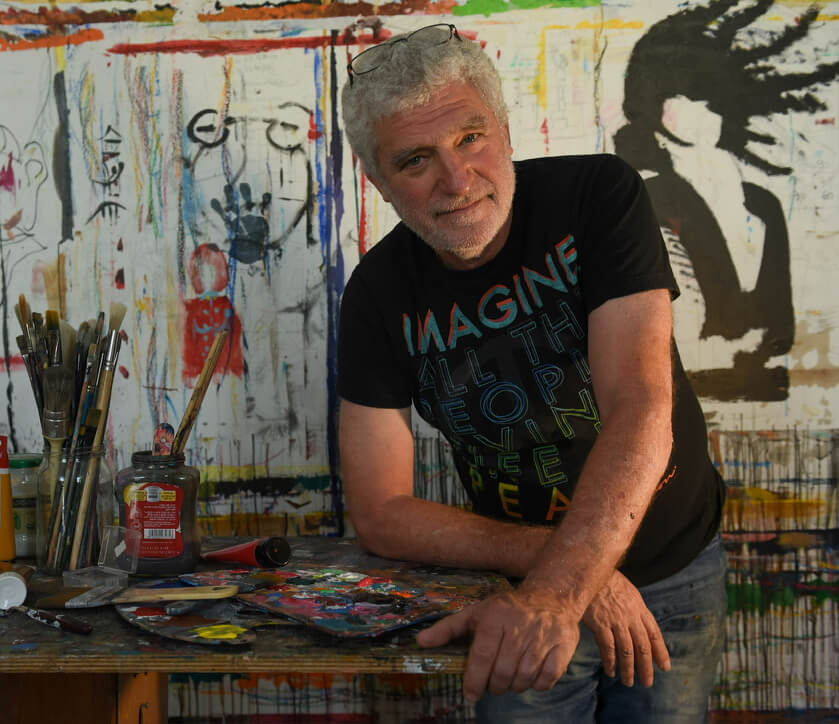
Micky Goldstein were born on November 12, 1960, in Santiago, Chile. In 1973, he immigrated to Israel with his family and has lived in Tel Aviv ever since.
From a very early age, Goldstein was drawn to painting. He remembers painting already in kindergarten, and by the age of five he instinctively understood perspective, often painting cars with partially hidden wheels as if he intuitively grasped spatial depth. Painting interested him far more than anything else, and throughout his childhood he preferred staying home to paint rather than playing outside with friends.
After completing his military service, Goldstein was accepted to study Visual Communication at the WIZO Haifa Academy of Design (then called Graphic Design). He studied there for four years, specializing in illustration and animation. During this time, he also worked for two years as a personal assistant to Abraham Eilat, focusing on printmaking techniques, particularly aquatint.
After graduating, Goldstein worked as a designer and provided creative and artistic services to a wide range of advertising agencies in Tel Aviv. His works have received both national and international awards.
He has illustrated children’s books, textbooks, poetry books, and created illustrations for the Israeli press. In the early 1990s, he published political cartoons in Yedioth Ahronoth, and between 2006–2009 in The Jerusalem Post.
In 1998, Goldstein began painting with artists on the autism spectrum. This experience deeply influenced both his personal life and artistic practice. Over the years, he has described this collaboration as a system of mutual exchange — giving and receiving — through which he shared his knowledge while learning from each participant the ability to create freely, without self-judgment.
About fifteen years ago, following a personal crisis, Goldstein chose to dedicate himself exclusively to painting. The transition from rational, precise, and planned work to emotionally driven painting was complex and demanding, but it became a transformative process. Today, he says that as long as he continues to create, he will never stop painting.
Curriculum Vitae – Micky Goldstein
Studies
2005–2006 — Art Workshop with Zim Yacob, Tel Aviv, Israel
1984–1986 — Art Workshop with Abraham Eilat, specializing in aquatint and engraving, Haifa, Israel
1983–1987 — WIZO Neri Bloomfield Academy of Art and Design, Haifa, Israel
Solo Exhibitions
2024 — Resonant Identity, Gabriel Cultural Center, North Israel
Curated by Ronit Halfon & Itzik Kochavi
2023 — Together Individually, Chagall Artists’ House, Haifa
Curated by Noa Ambar Regev
2022 — I’m Not Afraid of the Dark, Wertheimer Gallery, Tel Aviv
Curated by Hagit Peled Rotem
2018 — Perfect Imperfect, Lemon Frame Gallery, Tel Aviv
2017 — Iconic Portraits, Carmiel City Hall Gallery
2017 — Malaga Art Fair, Spain
2016 — Imagine, Irit Hadani Art Gallery, Tel Aviv
2001 — My Other Country, Petach Tikva Cultural Center
Group Exhibitions
2025 — In Balance, Wertheimer Gallery, Tel Aviv
Curated by Gil & Nathallie Wertheimer
2024 — Unveiled Summer, Wertheimer Gallery, Tel Aviv
2023 — Interface, Wertheimer Gallery, Tel Aviv
2022 — The Locked Garden, Wertheimer Gallery, Tel Aviv
2021 — Vita della Commedia, Lemon Frame Gallery, Tel Aviv
2020 — I Don’t Care, LAAP, Pompano Beach Cultural Center, Florida
Curated by Anaibis Yero
2015 — Llamado de los Ángeles, O’Higgins Institute, Santiago, Chile
2014 — The Sea, Givatayim City Hall
2013 — From the Andes Mountains to Jerusalem, Petach Tikva City Hall
2012 — The End of the World, Oren Meyuhas Gallery, Tel Aviv
2011 — Pregnancy, Ginger Giraffe Gallery, Mumbai, India
2011 — Windows to My Past, Rothschild 3 Gallery, Tel Aviv
2011 — 100 Years of Femininity, Rothschild 3 Gallery, Tel Aviv
2010 — Nude, Ramat Aviv Cultural Center
2009 — Present Time, Museum of Caricature, Holon
2007 — The Present Time, Museum of Caricature, Holon
2006 — La Femme, Miss et Art Gallery, Paris
2004 — 100 Years of Pablo Neruda, Tel Aviv University
Art Fairs
2024 — Miami Art Aqua, Latinoamerican Art Pavilion, Miami, FL
2023 — Miami Art Aqua, Latinoamerican Art Pavilion, Miami, FL
2021 — Fresh Paint Art Fair, Lemon Frame Gallery, Tel Aviv
2018 — Scope Miami Beach, 18th Edition, Booth A-19, Lemon Frame Gallery
2017 — Red Dot Art Fair, Booth 201-R, Lemon Frame Gallery
2017 — 1st International Contemporary Art Fair, Malaga, Spain
2012 — New York Art Expo, Steinhausen Gallery Booth, USA
Artist Statement – Micky Goldstein
My work is born from a deep need to paint rather than from a desire to reach a predetermined result. For me, painting is not about the final image, but about fully inhabiting the process itself. The act of painting is where meaning exists; the finished work is simply a trace of that journey.
In my world, there are no mistakes. Nothing is planned, yet everything unfolds with intention. I allow myself absolute freedom to change course, to listen to the painting, and to follow where it leads. Control and intuition exist side by side, constantly negotiating the path forward.
While painting, emotion becomes movement, rhythm, and decision. The canvas absorbs these moments and transforms them into presence. Once the work leaves the studio, it becomes a bridge — carrying my emotions toward the viewer and inviting theirs in return. Within this silent exchange, the artwork continues to live.