
Israel Cohen
For Portfolio
The Journey of The Soul to The Turquoise
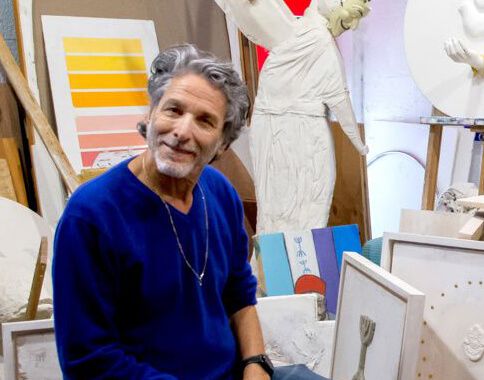
Israel Cohen's studio is buzzing. Dozens of paintings hang on the walls; sculptures and
objects are placed in every corner, portraying images of fish, hamsa, pomegranates and
angels. The colors white and light blue dominate most of them. It's a Mediterranean azure
that seems to have been brewed on the island of Djerba, which lies on the coast of southern
Tunisia, where Odysseus arrived on his long journeys. The island boasts a long holy history
and was home to one of the oldest Jewish communities in the world.
Cohen's ancestors and great-grandfathers were also born there. According to local tradition,
Jewish priests- Kohanim came to the island in the days of King Solomon and others joined
after the destruction of the First Temple. The multitude of synagogues on the island is
evidence of a large Jewish community that was and still exists on a small scale.
One might wonder what is the connection between Israel Cohen who was born and raised in
Jaffa in the Ajami neighborhood and those popular symbols embedded in plywood panels, in
industrial materials such as stainless steel, tin, copper and clay? In the past, Cohen was
engaged in painting, but left it in favor of construction and other businesses. During the last
decade his passion for art has begun to open his heart and claim a place for the ancient
heritage and tradition he had been a part of from early childhood, while hearing the stories
of his mother Fortuna, his father and grandfather, as well as a trip to Djerba in 2018, to
which he felt an immediate connection, with its colors and diving that gave him the feeling
that he was in Jaffa, "at home". While in Djerba, Cohen also visited the synagogue at the
Kohanim quarter, in the courtyard of which his grandfather is buried.
In an "Act of Mission" Cohen visits his studio every day for long hours to create art and to
create a world. As one of the members of the second generation to Aliyah, Cohen also
experienced a cut and a distance from the tradition of his home, which was accompanied by
the emotion of "Heshuma" (shame in Moroccan) and associated with the label of
"primitivism" and exile, the Zionist ethos had kindled in the name of the melting pot.
The point of reference for every culture is its past, its origins, its roots, whether the society,
the community, chooses to adopt it and continue to conduct itself according to it, or
whether it disapproves, rejects and disconnects and cuts itself from it. The past is essential
for the continuity of a culture, for its maintenance as a breathing and living thing. The
connection to the past, even if it is weak and loose, is a fundamental element in building an
identity; an identity that eventually organizes itself into a culture. "The return of the exiled
voice" as Habiva Pedaia defines the raising of the repressed voice from the forgotten
sounding board of the past, is connected with the urge, with a deep inner need of the
members of the second and third generations to reintroduce what was silenced and
inhibited - a rich and varied culture, multifaceted and of many colors . For Cohen, his family's
past is a driving force for reconnecting to the chain of generations.
The past is a material- like a shovel to dig into: in its layers, its voices, its symbols and its
stories. Cohen states that the legacy of his ancestors impassions him. The cultural archive
awakens and brings to life stories and times from the ancient temple whose Kohanim (
Jewish priests) came all the way to Djerba to dig up the holy azure and bring it to Jerusalem
and through the dark holocaust days of North African Jewry that still not many know about.
Cohen too, returns to his own temple. He digs out of the cultural archeology excavations
various models of coins and seals and creates them in materials and textures with an almost
earthly appearance.
On the coins he adds words and sentences in ancient letters that some of them he covers
with gold, perhaps as an echo of the gold collecting on a bitter day, from the homes of the
Jews in Djerba before they fled for their lives during World War II.
"With the same chalk a policeman marks a body at the scene of the murder/ I mark the
borders of the city where my life was shot. I interrogate witnesses, squeeze from their lips /
drops of Arak and hesitantly mimics dance steps/ of a Pita on a bowl of Hummus. [...] The
memory is an empty plate, scarred from scratches. A knife on her skin".
Thus writes poet Ronny Someck ("Bagdad", Revenge of the stuttering boy, Zmora – Bitan,
2017), while flirting with his Babylonian origin, with the memories and stories about the
market and fish restaurants by the Tigris river, about the synagogue and the singers whose
songs he grew up with, along with the attempt to get involved in a new homeland and
language. Cohen returns to the family past in his own way and acts as a researcher or as an
archaeologist. He reads about North African Jewry, he watches films about Djerba, listens to
ancient music and poetry and is influenced by rituals and religious ceremonies. He converts
the layers and traditions that cling to his soul into a work of art that moves between the past
and the present, between the realistic language, the partial use of Ready Mead and the
beginning of the process of abstraction. Like the blacksmith - the biblical blacksmith who
created a world by fire, Cohen applies the knowledge he gained in construction- in the
processes of planning the shapes, cutting the parts, joining and gluing and giving shapes in
stone and wood in a contemporary interpretation of the re-attendance of his culture and
Eastern Jewry consciousness.
On a board of plywood, putty and Korean plaster, he sculpts a Menorah of five reeds as the
number of five fingers, then he sculpts yet another Menorah, a strengthening multiplication
as a mirror script. And here is hamsa hamsa. In another panel, Cohen casts a group of metal
minnows with a crimson thread on epoxy resin, and in another work he sculpts a fish out of
wood and stone which he covers with newspaper in Arabic fonts. In a conversation with him,
Cohen says that most of the emigrants of Djerba were named after species of fish and thus
his studio full of Hamsa's and fish is like a testimony book of a community. His community. In
Jewish folklore and mysticism the fish is identified as an attribute of security and protection.
An image of a fish with a constant open eye also appears on the facades of the blue houses
in the Jewish Djerba.
Due to its ability to live under water, the fish is invisible and therefore the evil eye did not
control it. The eye is drawn and sculpted by Cohen, whether it is a small open eye located in
the middle of a panel and combined with symbols of abundance and texts, or whether it is a
large simple graphic eye surrounded by rays like a sun that overflows with hope.
Cohen believes that art is a tool to express his personal, spiritual and cultural truth. The
materials and forms that he repeats and assembles in countless variations and with the
richness of imagination are meant to produce a language that emerges from the inner
voices, the images, the memories that he saw and heard and from the childlike that did not
receive adequate inner expression in the past. "Memory", De Certeau points out, "answers
more than it draws." This is an active dubbing of the traces of the past while reviving them in
the present, this speech is a tactic, as defined by De Certeau, "for memory creates a place
that is not its place". "Memory turns to the event when it has already ended, and the one
who tells it does not reproduce the traces themselves, but rather their fragility". The doing is
the true memory, when the memory tells traces and remnants and does not just quote
them. (Eran Dorfman, "The writing of the everyday" in Michel De Certeau, The invention of
the everyday, Resling, 2012; 21-22).
Cohen's metal detector with which he goes to the beach from time to time does not only
find lost random materials, but brings up historical materials from the inheritance of
ancestors that now, through Cohen's art is not only his but also ours.
Thank you to Ronny Someck for the song.
Drorit Gur Arie